Operator playbook
Product Dimension Guides: Help Customers Check the Space Before They Buy
Create a homeware dimension guide that distinguishes product size, usable space and shipping measurements, with a storage-basket example and a practical worksheet.
 Soren Vex · · 10 min read
For: US and UK independent homeware retailers answering product-size and room-fit questions online.
The short answer
Name the exact product, show where each measurement starts and ends, and distinguish outside size, usable space and packed size. Give the customer a clear comparison task.
A product dimension guide should help a customer make a comparison. Name the exact item, label what each measurement describes and show where to measure at home. A bare list of numbers is incomplete when the buyer cannot tell whether it describes the outside, the usable interior or the shipping box.
For homeware, begin with the practical question: “Will this fit the space where I want to use it?” Then separate that from “Will my things fit inside it?”
Outcome and prerequisites
Prepare one maintained size explanation for a real product and a few campaign pieces that lead back to it. You need the current item or reliable verified measurements, its variant name, real photographs and someone responsible for confirming the facts.
This guide is for US and UK small homeware retailers. The fictional storage-basket example explains content preparation, not a tested product, a manufacturing tolerance or an installation recommendation. Products involving structural loads or safety-critical clearances need appropriate product-specific guidance.
Use the product page as the current reference. A separate guide can explain how to compare measurements, but customers should not have to guess which product or version it describes.
A usable answer first
Keep three records distinct: outside dimensions, usable dimensions and packed dimensions. Only publish the records relevant to the question, with their labels attached.
For a basket placed on a shelf, outside dimensions help compare the basket with the opening. For objects placed inside the basket, usable interior and access matter. Packed dimensions describe a delivery parcel and should not silently substitute for either.
Google's product-dimension documentation explicitly separates product measurements from shipping-dimension attributes. That distinction is useful for your customer explanation as well as for the person maintaining merchant data.
A useful answer names the comparison: “Measure your shelf's clear opening and compare it with this basket's outside dimensions, including the handles.” Add only the dimensions and conditions you have actually checked.
Worked brief
Imagine a homeware shop selling a rectangular storage basket in two sizes. A customer wants one for a hallway shelf and asks whether the smaller basket will fit. The product photograph looks close, but perspective does not provide a dependable measurement.
The shop prepares a front view, a side view and a view into the basket. It identifies whether the handles extend beyond the body, where the usable opening narrows and which variant is pictured. It records dimensions from the actual item rather than inventing numbers for a polished diagram.
The proposed guide asks the customer to measure the shelf opening, consider the space needed to move the basket in and out, and compare those constraints with the checked product record. It does not prescribe a universal clearance amount.
A second question concerns what goes inside. A basket that fits a shelf may still be too narrow internally for a folder. The page therefore keeps external footprint and usable interior separate, with labelled photographs showing their meaning.
This is more specific than a general product-answer framework. Our product facts and customer answers guide explains that broader preparation; this guide concentrates on measurement evidence and the customer's comparison task.
Steps and checkpoints
- Identify the item and variant. Record the exact model, size and measurement source. Do not combine the smaller basket's photo with the larger basket's numbers. Resolve a conflict between supplier data and the current item before publishing.
- Define each measurement. Name its start and end points and the item's condition. For the outside envelope, decide whether projecting handles are included and say so. For the interior, show the usable area rather than relabelling an outside measurement.
- Make units explicit. Keep one clearly identified primary unit. If you provide a converted value for another market, check the calculation and use sensible precision. A conversion does not make the original measurement more exact.
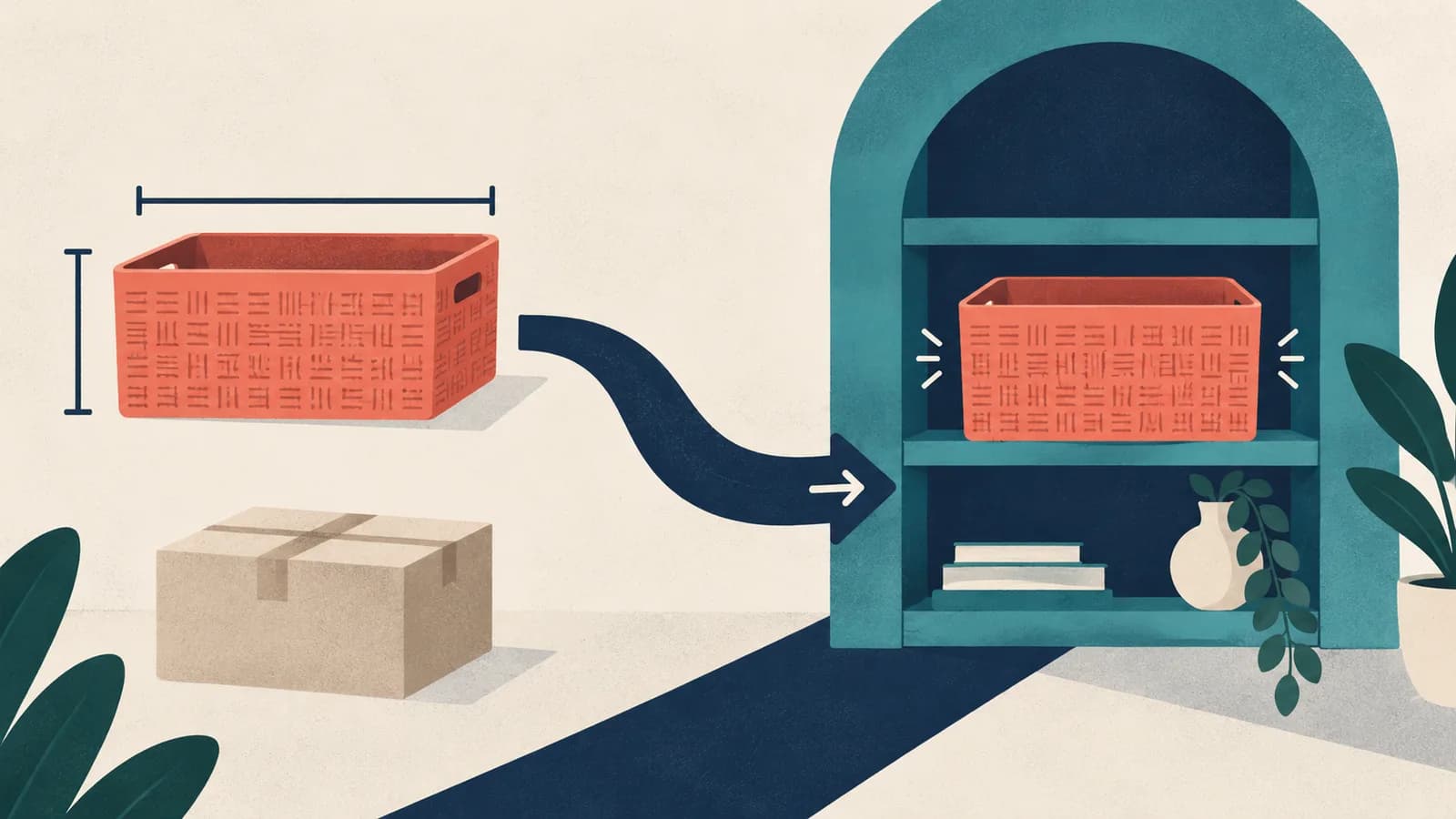
- Show the measurement in context. Use real product photographs with simple labels and a text explanation. Do not rely on text embedded in an image alone. The generated cover of this article is conceptual and must not be used as dimensional evidence for a real product.
- Put the explanation where the decision happens. Shopify's metafield guidance gives product dimensions as an example of information that can appear in a dedicated theme section. Whatever your platform, inspect the actual customer page on a phone and check the selected variant.
- Verify any data export separately. Google requires consistent units across product length, width and height in its dimension attributes. A readable page and a valid merchant feed are separate checks; writing the guide does not update the feed automatically.
Finish with a comprehension check: ask someone to point to the shelf measurement they need and the product value they would compare it with. If they choose the shipping box, improve the labels before making more promotional content.
Reusable worksheet
This example intentionally leaves numeric measurements to the product owner. Copy the field names into a blank record and add checked values, units and photographs.
| Field | Storage-basket record |
|---|---|
| Exact item | Current small basket variant |
| Outside envelope | Body plus any projecting handles |
| Usable interior | Space available for stored objects |
| Entry opening | Narrowest relevant access point |
| Home comparison | Clear shelf opening and access route |
| Separate record | Packed parcel measurements |
| Evidence | Labelled actual-item photos and checked values |
| Review trigger | Supplier, construction or variant change |
Add the measurement date, source, reviewer and reference-page URL. If a dimension is approximate, explain what the approximation means using appropriate product evidence; do not invent a tolerance to make the table look complete.
For handmade products, variation requires a separate explanation. Our handmade-product variation guide helps distinguish buyer choices from accepted differences between pieces. It does not supply a measurement tolerance for your basket.
Failure modes
A size name does all the work. “Small” only distinguishes options within your range. Add the measurements and the comparison method that make the label useful.
The image silently changes scale. A composite scene can make a basket look smaller than it is. Use a real contextual photograph or a clearly labelled conceptual image, with measurements in accessible text.
Outside and inside measurements share one heading. Rename the fields and show which question each answers. A customer should not have to infer the distinction from two unexplained sets of numbers.
Converted values imply false precision. Long decimal strings can suggest more accuracy than the source measurement supports. Check conversion and rounding without turning an estimate into a guarantee.
A dimension becomes a performance claim. A basket's width does not prove its load capacity, durability or suitability for every shelf. Keep those claims tied to their own evidence.
A clear page is called an AI-search win. Clear, specific answers make the information easier to inspect and reuse. They do not prove indexing, rankings or inclusion in an AI response.
From one-off to recurring
Once the measurement explanation is reliable, it can support a short measuring demonstration, a size-comparison post and an answer to a common fit question. Each format should point back to the current product reference and preserve the same definitions.
Try MultiCast when turning those checked facts into a regular branded campaign is the part that keeps getting postponed. Its public product page describes campaign planning, brand-guided voice, use of supplied photographs and per-piece approval. Those are relevant capabilities to evaluate with one complete dimension brief.
The practical attraction is a common creative starting point: the product names, approved photos and measurement explanation travel with the campaign instead of being reconstructed for every post. Review the short caption and image labels as carefully as the longer guide.
For one occasional update, a shared document may be enough. MultiCast becomes more relevant when the same product knowledge needs to support recurring content. This recommendation concerns preparation, not automated measurement, inventory synchronisation or merchant-feed updates. Find adjacent clarity checks in our search and discoverability guides.
Evidence and updates
Sources checked October 13, 2026. Google supplies merchant-data rules; Shopify describes a way to organise product fields; MultiCast supplies advertised capabilities. The basket scenario and worksheet are original planning proposals, not observed customer results.
Google Trends views for “size guide” in the United States and United Kingdom over the past 12 months contained broad and mixed intent. They did not establish rising demand for homeware measurement guides. The editorial reason to act is the concrete buyer question.
The geometric cover is generated conceptual art, not a scale diagram. Review the guide whenever the product or measurement source changes, and check the current platform rules before exporting its data.
 MultiCastMARKETING, TOGETHER.
Good ideas deserve a consistent campaign.
Bring your next marketing idea to MultiCast. Keep your brand at the center, from planning to publishing.