Operator playbook
AI Shopping Starts with Clear Product Answers: Turn Specs into Useful Content
Turn product specifications into supported buyer answers, then reuse the same facts in branded content. Includes an AI-shopping brief and practical worksheet.
 Soren Vex · · 11 min read
For: US/UK small-business owners preparing their own recurring marketing.
The short answer
Connect each buyer question to a direct answer, a verified product fact and a boundary. Publish the complete explanation, check merchant-data requirements separately and reuse the brief across branded content.
Product specifications become useful shopping answers when they explain a decision. “32 cm wide” is a fact. “Check the usable opening against the item you want to carry” tells a buyer what to do with it. Keep both: the exact specification and a supported explanation of its meaning.
For a small business preparing for AI-assisted shopping, that is a practical content task you can start now. Build clear answers on your own product pages, then carry the same checked facts into the content that brings people there.
Outcome and prerequisites
Create an answer brief for one product: three buyer questions, evidence for each answer, an important limitation and a current destination. Use it to improve the product explanation and prepare a small set of supporting posts.
Start with the actual product version, specifications, available variants, instructions and an owner who can resolve uncertainty. Keep unsupported assumptions out of the brief. This workflow can help US and UK merchants prepare clearer content; availability of individual Google shopping features must be checked separately.
The timely trigger is Google's September 16, 2026 holiday-shopping announcement. It encourages merchants to keep product information accurate and add richer context, including conversational attributes. That makes the quality of a product answer a concrete preparation issue, not just a prediction about future search.
A usable answer first
Use a four-part answer:
Question → direct answer → supporting product fact → boundary or next check.
For example: “Will this sleeve fit my laptop? Compare your device's dimensions with the sleeve's usable interior and opening. The product page should give those measurements. A matching screen-size label alone is not enough to establish fit.”
That is a proposed answer structure, not a claim about a particular sleeve. Once you have measured the product, replace the general instruction with exact supported details.
| Product information | Buyer decision | Answer the content should support |
|---|---|---|
| Usable dimensions and opening | Will my item fit? | What to measure and compare |
| Material and confirmed care instructions | Does it suit my routine? | How to use and maintain it |
| Differences between variants | Which version should I choose? | What changes and what stays the same |
These connections are the useful work. Adding “AI optimized” to a description does not do it.
Worked brief
Imagine a small maker selling two sizes of a padded laptop sleeve. This is a fictional planning example, not a tested product or client result.
The owner has external dimensions, measured usable interior dimensions, photographs of the opening and confirmed cleaning instructions. There is no documented drop test or waterproof rating. The variants share the same fabric but differ in usable space.
A weak brief asks for “a compelling description of a premium protective sleeve.” A better one asks for three answers: how to check fit, which size to select, and how to clean this material. It also records two exclusions: do not promise drop protection or waterproofing.
That brief gives the writer enough direction to be useful and gives the owner specific statements to verify. The product can still sound appealing through accurate detail: a clear explanation of the opening, lining and intended everyday use has more substance than a string of superlatives.
Steps and checkpoints
-
Separate facts from interpretations. Record the specification, where it came from and which version it describes. A supplier's material description and your own measurement are different evidence types. Resolve discrepancies before publishing.
-
Choose questions that change a purchase. Start with fit, use, care, compatibility or variant choice. Ask whether the answer could help someone select another option or decide not to buy. If it cannot affect a decision, it may be decoration.
-
Write the direct answer first. Give the useful instruction in the opening sentence. Place the supporting fact and its condition immediately after it. Avoid an introductory paragraph about the importance of quality when the reader needs a measurement.
-
Publish the complete explanation at the product destination. Keep specifications, images and answer text consistent. Use meaningful headings and link to the current variant. Our service-page clarity audit provides a related check for scope, conditions and next actions; apply those principles to the product rather than copying service-specific fields.
-
Check the relevant merchant-data route separately. Google's conversational-attributes documentation describes optional product data such as question-and-answer pairs, document links and variant information. It recommends supplemental data sources and says not to duplicate details already supplied in description, product highlights or product details. Review the current specification for your actual attribute and account before implementation.
-
Carry the checked answer into each content format. A carousel can compare the two sizes, a short clip can demonstrate the opening, and an image post can explain care. Compare every draft with the same brief, including any text in artwork or narration.
Merchant Center data and public editorial content are separate publishing tasks. A blog FAQ or a social caption does not automatically populate a feed. You can improve the customer explanation today while the person responsible for your merchant integration checks the technical requirements.
Reusable worksheet
This filled example deliberately leaves measurements as an owner task. Invented dimensions would make the answer look finished while making it less trustworthy.
| Field | Sleeve example | Check |
|---|---|---|
| Question | Will my laptop fit? | Uses a real buyer decision |
| Evidence | Inside size and opening | Measure this size |
| Answer | Compare your device with these sizes | Add checked values |
| Limit | A screen-size tag does not prove fit | No claim of fit for all |
| Visual | Show where to measure | Actual item shown |
| Link | Current sleeve and size guide | Check size and details |
| Owner | Product owner | Name in private brief |
For your own product, fill in: question, exact answer, evidence source, version, limitation, destination, content formats, reviewer and next review trigger.
Use a second row for variant selection. Explain the difference that matters: usable space, included accessories or a supported functional change. Do not label the larger version “better” when the smaller one fits the customer's needs.
A third row can cover care. Copy the verified meaning of the instructions, then make the action easier to understand. Do not invent a cleaning method because it fits neatly into a video.
Failure modes
The answer silently upgrades a claim. “Padded” becomes “drop-proof,” or a material description becomes “waterproof.” Remove the stronger wording unless the product evidence supports it.
The short post loses the exception. A carousel card that says “fits your laptop” can contradict the careful product page. Put the measurement check where the promise appears.
The page and variant disagree. Check the selected size, images and destination together. Clear copy for the wrong version is still wrong.
Every answer is copied into every field. Read the platform's data specification. More repeated text is not a substitute for using the correct field and supplying genuinely useful information.
A platform announcement becomes a ranking promise. Clear content is preparation, not evidence of search inclusion. There is no supported shortcut here to a guaranteed AI recommendation.
From one-off to recurring
Once the product answers are sound, MultiCast is a useful place to turn them into recurring marketing. Its public product description brings together Brand Kit direction, images, carousels, short videos, campaigns and scheduled channel publishing.
We recommend trying MultiCast with one approved product-answer brief. Use the same brand voice and visual direction for a size-comparison carousel, an opening demonstration and a care post. Review each against the checked facts, then schedule a coherent set that leads back to the product explanation.
The benefit is a connected production routine: the useful answer stays at the centre while the format changes. That is especially relevant when an owner is responsible for both the product and the marketing. MultiCast gives the campaign a common home for brand direction, creation and publication; you supply the product knowledge that makes it credible.
This recommendation concerns content creation and publishing, not an automatic Merchant Center connection. No feed synchronization, UCP integration or AI-ranking result was established for this article. Keep those technical decisions separate from the clear marketing workflow.
When a specification or offer changes, use the content update map to find the pages, scheduled pieces and reusable materials that repeat it. Then prepare the next set from the corrected brief. Learn more about MultiCast's marketing workflow.
Evidence and updates
Sources checked September 23, 2026. Google provides the platform announcement and attribute guidance; MultiCast provides its public capability descriptions. The answer structure, worksheet and sleeve example are original editorial proposals, not a tested campaign or an implementation guide for a particular merchant account.
We also inspected Google Trends for “AI shopping” and “social search”, United States, past 90 days, Web Search, search terms. That view did not establish sustained growth for “AI shopping.” The reason to act here is the documented platform change and the usefulness of accurate answers, not an asserted keyword boom.
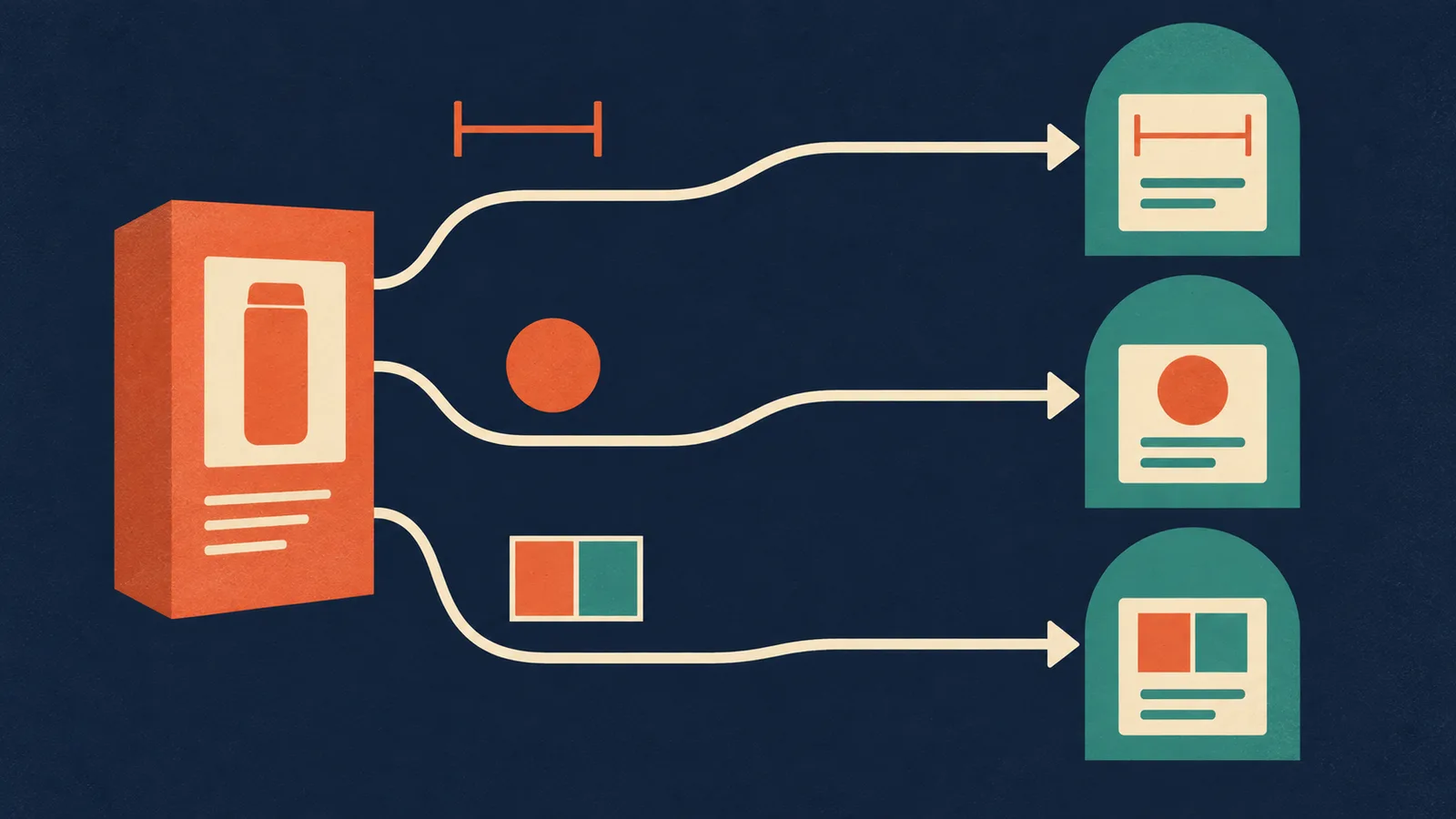
The cover is generated conceptual artwork. Recheck the platform documentation on October 23, 2026, and revise the product brief whenever specifications or available variants change.
 MultiCastMARKETING, TOGETHER.
Good ideas deserve a consistent campaign.
Bring your next marketing idea to MultiCast. Keep your brand at the center, from planning to publishing.