

Why Organic Reach Suddenly Flatlines
An abrupt halt in views is rarely an algorithmic penalty. It is a mathematical boundary where a post exhausts its initial audience and fails the retention threshold for broader distribution.

It is a familiar pattern for anyone who monitors analytics dashboards. A piece of content goes live and immediately finds an audience. The initial curve is steep and promising. Impressions accumulate, interactions register, and the trajectory suggests a breakout performance. Then, abruptly, the momentum vanishes. The upward slope turns into a hard horizontal line.
This sudden halt in organic reach often prompts suspicion of an algorithmic penalty. Creators and solo operators frequently assume their account has been flagged or suppressed by the platform. In reality, a sudden flattening of the distribution curve is rarely punitive. It is a mathematically precise boundary. The post has simply encountered a structural limit within the distribution model, exhausting its initial audience without generating the behavioral markers that trigger further expansion.
To understand why this happens, it helps to observe how content is actually routed through modern networks. We are no longer operating in an era of chronological feeds or pure follower-based broadcasting, where every post is delivered to a static list of subscribers. The architecture of distribution has shifted toward continuous, dynamic evaluation.
The Initial Micro-Cluster Test
When a new piece of content is published, it does not go to a complete follower base at once. Instead, the system initiates an evaluation phase. The content is served to a small, highly targeted micro-cluster of users. This group acts as a sample size, allowing the platform to measure immediate behavioral responses before committing further computational resources to the post.
Historically, this initial cluster consisted of a creator's most active followers. Today, the selection is increasingly governed by an interest graph. Because of this shift, a new post might be tested on users who have never interacted with the account before, provided their recent behavior suggests they might be receptive to the topic at hand.
The composition of this micro-cluster is highly deliberate. The system appears to look for users who are currently online and whose recent scrolling behavior aligns with the metadata and historical performance of the creator's past work. By serving the content to this highly primed group, the platform establishes a baseline measurement. If it cannot hold the attention of this core group, it rarely propagates elsewhere.
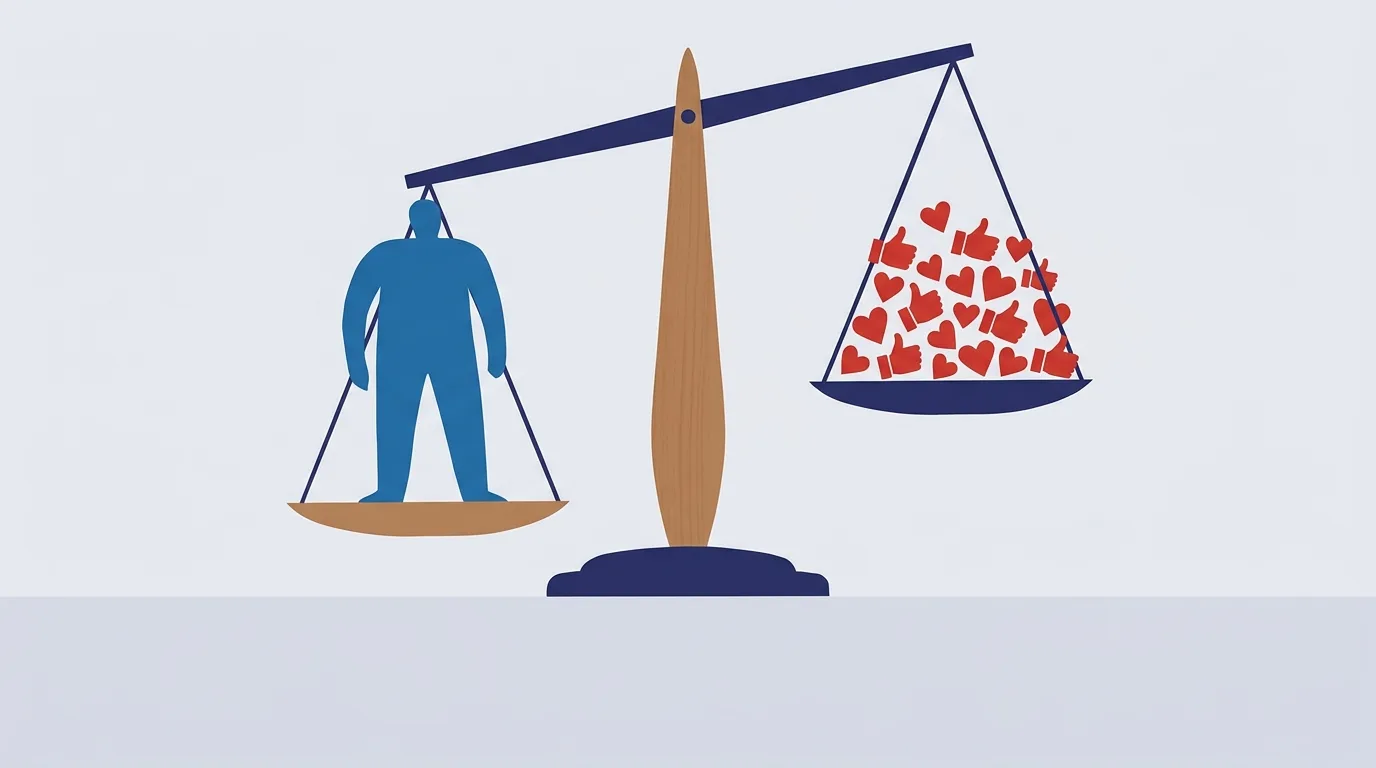
During this initial test phase, the system calculates specific performance metrics against a predetermined baseline. Every platform weighs these metrics differently, but the underlying principle remains consistent across the industry. Deep engagement signals tend to carry significantly more weight than passive interactions. A standard like is a relatively weak indicator of interest, requiring minimal effort from the user. Conversely, metrics that demonstrate sustained attention—such as video completion rates, extended dwell time, saves, and shares—are treated as strong indicators of value. The algorithm monitors these signals closely, looking for evidence that the content can retain user attention over time.
Hitting the Retention Boundary
Algorithmic distribution operates in expanding waves. When a post maintains strong retention metrics within its first sample group, the system typically broadens the delivery radius to a larger, slightly more diverse audience. Continued resonance at this stage often prompts further expansion into even wider demographic pools. This process continues as long as the post maintains a sufficient velocity of positive signals relative to the size of the audience it is reaching.
A reach plateau occurs at the moment a post fails to meet the required engagement threshold for its current tier. It is not that the system decides to arbitrarily hide the content; rather, the content simply fails to justify further expansion. The initial micro-cluster might have found the post highly relevant, resulting in that steep initial curve. But as the distribution wave expands outward into adjacent, less closely aligned interest clusters, the resonance naturally drops.
We can see this clearly when examining retention graphs alongside reach metrics. A highly technical post might perform exceptionally well with a core group of specialists. They watch it to the end, they save it for later reference, and they share it with peers. The system registers this success and pushes the post to a broader group of generalists. The generalists, however, do not share the same depth of interest. They swipe away after three seconds. They scroll past without pausing to read the caption.
These negative behavioral signals act as a mathematical drag on the post's overall score. Rapid swiping, early exits, and low watch times communicate to the system that the content is no longer holding attention. Because platforms optimize heavily for overall user retention—their primary goal is keeping people on the app—they are highly sensitive to these drops in performance. Once the aggregate score falls below the required engagement threshold for that specific distribution tier, the expansion stops. The post has reached its natural limit.
Every platform builds a decay function into its distribution model. As a post ages, the threshold for continued distribution tends to rise, requiring an even higher concentration of positive signals to maintain the same outward momentum. This means a post must not only find a wider audience but must also engage them more intensely than the initial group just to keep the distribution wave moving forward. It is a compounding difficulty curve that very few pieces of content can sustain for more than a few days.
When Niche Appeal Fails to Scale
Understanding this mechanism changes how we interpret a flatlining view count. An abrupt halt is simply the exhaustion of a specific audience radius. The content successfully saturated the micro-cluster that was most likely to engage with it, but it lacked the broad appeal necessary to trigger engagement in larger, more generalized populations.
This dynamic explains why highly niche content often experiences the most dramatic plateaus. The alignment with the initial interest graph is so strong that the early metrics are overwhelmingly positive. The system pushes the content outward rapidly, riding a wave of high engagement. But it eventually hits a wall when the topic's inherent appeal runs out. The drop-off in engagement from the broader audience is steep, and the resulting algorithmic response is equally abrupt. The line on the chart goes flat because the mathematical requirement for the next distribution wave was missed by a significant margin.
By examining the exact timestamp where the velocity drops, analysts can often deduce the exact demographic layer where the content lost its relevance. If a post flatlines at sixty minutes, it likely failed to bridge the gap between core followers and immediate network adjacencies. If it climbs steadily for twelve hours before stopping, it probably succeeded in reaching secondary interest clusters but failed to resonate with the platform's broader, untargeted user base.
It is also worth noting that a plateau is a permanent state for the vast majority of content. While some posts experience secondary waves of distribution—often triggered by external traffic, a sudden shift in broader user interests, or a delayed accumulation of shares—most content remains at its plateau indefinitely. The social media algorithm has successfully categorized the post, measured its appeal, and determined its final placement within the network.
For those studying these patterns, the data offers a clear narrative. A sudden stop in distribution is an accurate measurement of a post's current appeal radius. It is a reflection of a system acting as a strict filter for attention, ensuring that only content capable of sustaining broader interest continues to spread. Recognizing this boundary allows operators to analyze their retention metrics objectively, rather than searching for punitive explanations where none exist. The plateau is merely the point where the math of mass appeal no longer works in the content's favor.
For a connected idea, see How Engagement Velocity Predicts Reach.
A neighboring perspective: How Private Shares Replaced the Public Like.
More to read
 Kai Renner · Growth & Algorithms Analyst
One Rewatch Outweighs a Hundred Likes
While marketers continue to chase traditional engagement signals, modern algorithms treat a complete rewatch as mathematical proof of content density.
 Kai Renner · Growth & Algorithms Analyst
One 'Not Interested' Erases a Hundred Likes
A quiet mathematical asymmetry governs modern feeds. Positive interactions add incremental reach, but active rejection acts as a severe multiplier that can erase all momentum.
 Kai Renner · Growth & Algorithms Analyst
The Expansion Click Starts the Clock
On text-heavy platforms, passive scrolling is mostly ignored. The algorithm's clock only starts when a user expands a truncated post.