Operator playbook
Instagram Trial Reels for Small Businesses: Test a Story Before Building the Campaign
Use Trial Reels to explore a customer explanation, record the limits of organic results and turn useful feedback into a consistent next campaign.
 Kai Renner · · 9 min read
For: US and UK independent retail brands preparing organic Instagram content with accurate footage and access to account publishing controls.
The short answer
Name one production decision, keep a version record, inspect results at comparable ages and choose keep, revise or inconclusive. Trial distribution is public and not a controlled A/B test.
Trial Reels can help a small business explore an unfamiliar content idea before deciding whether to share it more widely. The useful outcome is a production decision: keep this explanation, change it or stop spending effort on it.
Start with something you genuinely need to learn. A higher view count alone is a poor answer to “Which story should we tell next?”
Outcome and prerequisites
Prepare a short trial brief, a review record and one next action. This guide is for US and UK owner-operated brands using organic Instagram content, with accurate material and access to the account's publishing controls.
You need a specific customer question, a permitted video, the offer it describes and someone responsible for checking the results. Inspect your own account for the Trial control before planning around it. This guide does not establish access for a particular account or test Instagram's current interface hands-on.
A usable answer first
Choose one change that could improve understanding. Write down what you will inspect, when you will inspect it and what would make you revise the content.
Meta's Trial Reels announcement describes showing a Reel to non-followers first, with engagement information available after roughly 24 hours. You can then decide whether to share it with everyone. Some followers may still encounter a trial through a share or another surface, so it is not a private test.
Meta later announced wider availability in June 2025. These announcements explain the feature; they do not promise a result for your shop.
For an owner-led learning exercise, consider leaving automatic sharing off until you have reviewed the message and response. Meta describes optional automatic sharing based on views during the first 72 hours. That is a platform decision rule, not your business's acceptance test.
Worked brief
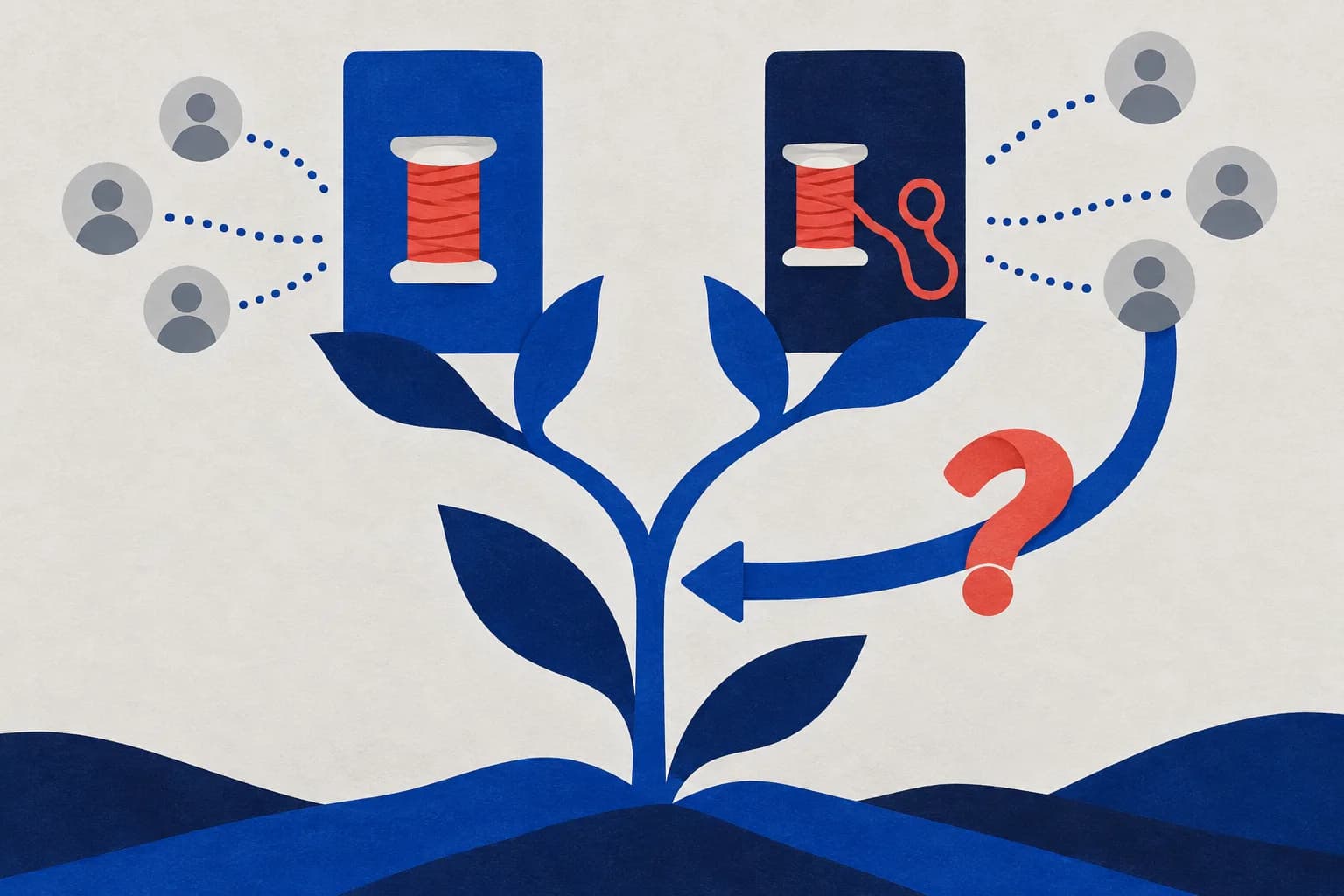
Imagine a fictional independent sewing shop introducing a beginner repair kit. The kit contents and instructions are confirmed. The shop wants to learn whether a plain opening makes the repair task easier to understand than a product reveal.
The first opening says, “Meet our new repair kit.” The second says, “A loose button? Here is the first step before you sew it back.” Both lead into the same truthful demonstration of the kit and the same next action: read the contents and instructions.
The change is the opening explanation. The shop does not also replace the offer, music, demonstration and destination, then credit one sentence for every difference.
Before publishing, the owner writes: “If responses suggest viewers understand the task and want the relevant instructions, we will prepare another task-led explanation. If they ask what is included, we will make the contents clearer. If the response is too limited, we will leave the decision open.”
Those are editorial choices, not a forecast or measured customer result.
Steps and checkpoints
- Name the decision. Replace “get more reach” with a choice such as whether to invest in another repair demonstration. Our creative-test planning guide explains why the decision comes first. Its paid-ad setup requirements are separate from this organic exercise.
- Keep a small version record. Save the opening, main footage, offer and destination. Note every meaningful change. Output: a record that explains what the two pieces actually differ on.
- Check the explanation before distribution. Can an unfamiliar viewer identify the task and product? Use the product-demo shot plan if the deciding action is hidden or skipped.
- Inspect the account's Trial and sharing controls. Choose deliberately, rather than assuming an external scheduling tool exposes them. Record the publication time and the sharing setting you selected.
- Review at a comparable age. Use the same elapsed time for each observation and the metrics actually available to your account. Treat the first review as provisional; avoid refreshing until a favourable number appears.
- Read the response in context. Note relevant questions, confusion and off-topic reactions alongside the available counts. Do not invent a comment when nobody asked one.
- Make the next production choice. Keep, revise or leave inconclusive. Write what you will do differently in the next piece.
This is a directional learning routine. Ordinary organic distribution does not give you randomly assigned, equivalent audiences. Even with one deliberate change, two trials cannot prove that the opening caused a difference.
Reusable worksheet
Use the completed example to build your own private record. Keep the decision and observation separate.
| Field | Sewing-shop example | Fill in for your trial |
|---|---|---|
| Production choice | Make another task-led repair clip? | One next decision |
| Deliberate change | Repair question replaces product reveal | Exact opening or treatment |
| Kept stable | Kit, main demonstration, next action | Material and offer |
| Review point | Same elapsed time after each publication | Time and responsible person |
| Useful observation | Questions show clarity or missing information | Actual response, including none |
| Invalid or limited evidence | Offer changed; sharing setting differed | Changes and gaps |
| Next action | Keep, revise or leave open | Reason and next brief |
If the task-led clip gets more views but the few questions are about an unrelated trend, that does not answer the production question. If the reveal gets fewer views but exposes a missing contents explanation, that can still give the owner a useful correction.
Both situations are hypothetical. Neither establishes sales, statistical significance or a universal winning format.
Failure modes
A trial becomes a secret draft. It is distributed content. Resolve inaccurate claims, permissions and product details before posting, rather than using unfamiliar viewers as an accuracy check.
The sharing setting becomes the verdict. Automatic wider sharing can happen without satisfying your editorial criteria. Recheck the actual controls and choose the review involvement your business needs.
Different exposure becomes proof. Audience, timing and distribution may differ. Keep those limitations in the record and repeat a promising idea before building the whole campaign around it.
One quiet post kills a useful explanation. Sparse response can leave the question unresolved. Improve clarity, inspect the material and decide whether another attempt is worthwhile.
A view is counted as a buyer. Attention, understanding, enquiries and orders are different observations. Use the existing information you can interpret; no extra tracking system is required to write a better brief.
From one-off to recurring
Keep the learning sentence with the campaign: what you tried, what people actually did or asked, and what the next piece should explain. Then a trial informs the next campaign instead of becoming another isolated video file.
Try MultiCast when this repeated preparation is the part taking over your evenings. Its public product description brings campaign planning, brand-led content and publishing together. That makes it a relevant place to prepare a coherent next set around an approved customer question, rather than rebuilding the brand direction for each post.
Bring the confirmed offer, permitted material and useful learning into the brief. Review the generated pieces against those inputs. Check the supported publishing controls separately: this article does not establish that MultiCast publishes Trial Reels, selects Instagram's sharing toggle or automatically imports trial insights.
The advantage to evaluate is connected preparation. Instagram supplies the trial surface; your business supplies the decision; MultiCast can be assessed for keeping the resulting campaign on brand.
Evidence and updates
Platform and product references checked October 5, 2026. The sewing shop, decision rules and worksheet are original hypothetical examples. No Reel, account experiment or MultiCast integration was tested for this article.
Google Trends was inspected for US and UK Web Search over the past 12 months. Related UK searches included questions about using Trial Reels; the check did not establish a current US surge or demand for this particular guide. The cover is generated conceptual artwork, not analytics evidence.
Review the platform guidance by November 5 and recheck the account controls before each trial.
 MultiCastMARKETING, TOGETHER.
Good ideas deserve a consistent campaign.
Bring your next marketing idea to MultiCast. Keep your brand at the center, from planning to publishing.