
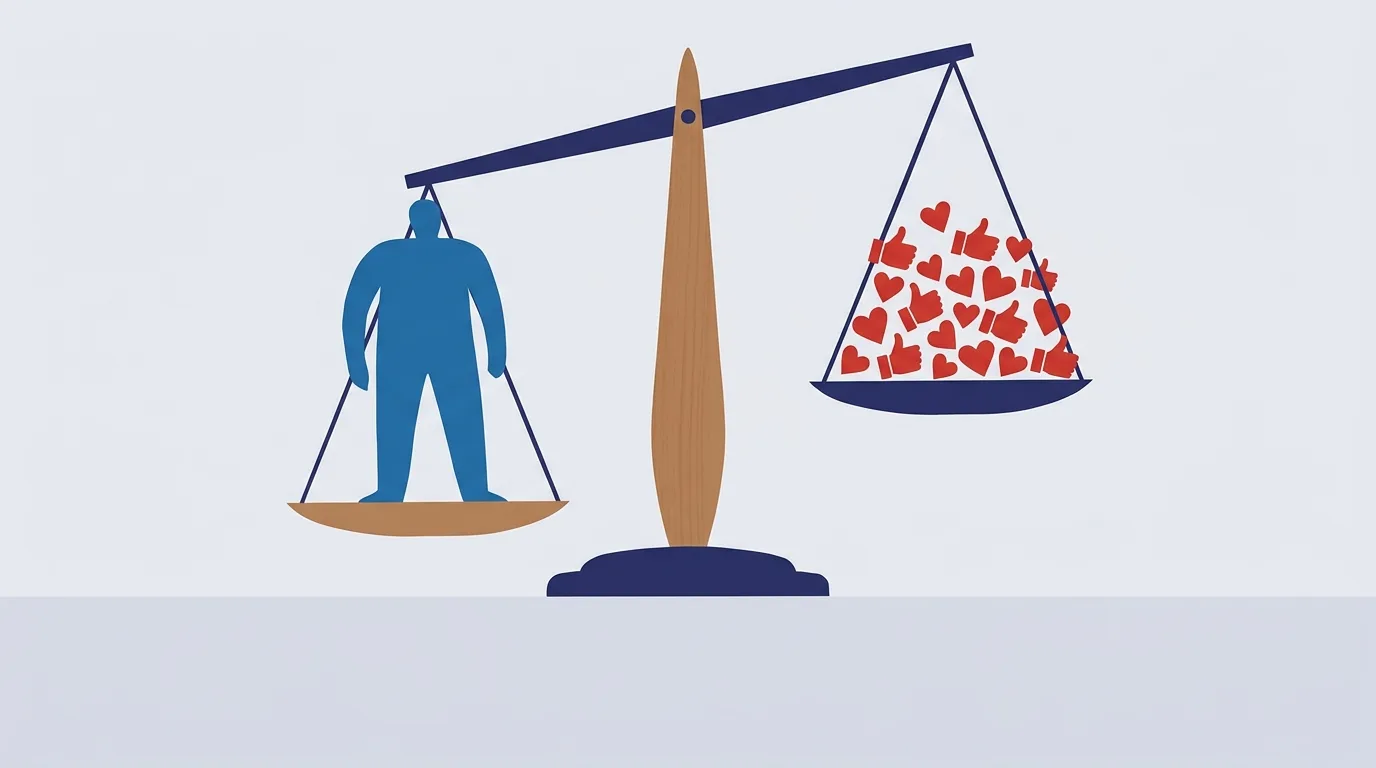
One Rewatch Outweighs a Hundred Likes
Modern distribution algorithms treat a complete rewatch as mathematical proof of content density. Traditional likes are now weak signals compared to the exponential weight of the second loop.

For years, the double-tap was the primary currency of the social web. A user scrolled, saw something mildly amusing or aesthetically pleasing, and tapped the screen. It was an explicit endorsement, and early recommendation engines built their entire architecture around accumulating these actions. But as user behavior matured and feeds became infinitely scrolling endless streams, the like became an involuntary reflex. It transformed into a habitual twitch rather than a genuine indicator of quality. Today, platforms appear to value this action at exactly what it costs the user: practically nothing.
Instead, modern systems have shifted their attention to implicit behavioral data. They measure the pauses, the hesitations, and the quiet moments of sustained attention. They track dwell time to the millisecond, evaluating how long a user hovers over a post before moving on. Among these implicit signals, one metric tends to correlate most strongly with explosive, sustained reach: the complete rewatch. When a viewer reaches the end of a video and allows it to play again, the system interprets this as mathematical proof of content density. It suggests the material contains enough value, nuance, or entertainment to warrant a second viewing.
In earlier iterations of social feeds, a large follower count guaranteed distribution. A creator with a million followers could post mediocre material and still generate massive engagement simply through sheer volume of impressions. Modern feeds have largely abandoned this model in favor of content-first distribution. Every piece of media is evaluated independently. A brand-new account with zero followers has the same theoretical access to the feed as an established media company, provided the underlying retention metrics justify the exposure. This levels the playing field for small-business owners and independent operators, but it also means that historical goodwill cannot save a poorly structured post.
The Weight of the Second Loop
To understand how a platform decides what to push to a wider audience, it helps to look at how it categorizes user interactions. Explicit engagement signals—likes, comments, and shares—are conscious choices. Implicit signals, like completion rates and replay frequencies, are subconscious behaviors. Over the last few development cycles, the balance of algorithmic power has shifted heavily toward the subconscious.
When a video enters a feed, the algorithm pushes the content to a small test cohort and measures the response. Here, the second loop acts as a powerful multiplier. If a significant percentage of the initial cohort watches the video all the way through and then begins watching it again, the system registers a massive spike in retention.
This introduces the concept of relative watch time, which measures the percentage of a video completed by the average viewer. Achieving a perfect completion rate is already a rare and strong indicator of quality. Surpassing that threshold by triggering a rewatch is one of the strongest possible growth triggers in modern algorithmic distribution. Platforms are highly motivated to keep users engaged on the app, and a video that successfully traps attention for multiple cycles is inherently valuable to the platform's bottom line.
Conversely, attempting to manipulate these retention metrics with misleading hooks tends to backfire predictably. If a video promises a specific payoff in the opening seconds but fails to deliver, viewers will abruptly scroll away. Recommendation engines actively penalize these sharp mid-video drop-offs. The initial surge in viewership from a clickbait opening is quickly choked off when the system realizes the retention graph resembles a steep cliff. Sustained attention is required to validate the initial impression.
Information Density as a Signal
Earning a rewatch rarely happens by accident. It is usually the result of deliberate structural decisions made during the production of the content. One observable tendency among high-performing media is the use of high information density.
When a video is packed with rapid-fire data, complex visuals, or fleeting on-screen text, a single viewing is often insufficient for the audience to absorb everything. The viewer reaches the end feeling that they missed a crucial detail, prompting an immediate replay. This is not a deceptive trick; it is a fair exchange of value. The creator delivers a dense package of utility, and the viewer pays for it with an extended block of their attention.
This mechanism is particularly relevant for instructional or analytical material. If a tutorial moves briskly and layers text over fast cuts, the audience naturally loops the video to catch the exact phrasing or the specific tool being used. The rewatch rate climbs naturally because the content demands it. The algorithm, blind to the actual subject matter, simply sees a piece of media that holds human attention at an exceptional rate of 130 percent or more, and adjusts its distribution accordingly.
Structural Mechanics of the Loop
Beyond pure information density, the physical structure of the media plays a role in how viewers interact with the timeline. A common pattern in highly distributed short-form video is the seamless loop. This occurs when the final frame of the video and the first frame are identical, and the audio track is cut to bridge the gap without a discernible break.
The effectiveness of this technique lies in human psychology. We are conditioned to look for cues that a piece of media has concluded: a fading screen, a concluding phrase, or a moment of silence. When these cues are removed, the viewer often begins the next cycle before realizing the first one has ended. By the time they recognize the repetition, they have already contributed several seconds of watch time to the new cycle.
This structural choice effectively bypasses the psychological cue to scroll. It inflates the average watch time without requiring the viewer to make an active decision to stay. While it might seem like a minor technical detail, at the scale of thousands or millions of impressions, these extra seconds compound. A seamless transition can easily push a borderline video over the threshold required for broader syndication.
The shift away from explicit likes toward implicit retention signals reflects a maturing digital landscape. Platforms are no longer asking users what they enjoy; they are watching what users actually do. For those operating independent media projects or commercial accounts, this changes the nature of the assignment. The goal is no longer to prompt a fleeting reaction or a casual double-tap. The objective is to construct something dense enough, or seamless enough, that a single viewing simply leaves the audience needing more.
More to read
 Kai Renner · Growth & Algorithms Analyst
One 'Not Interested' Erases a Hundred Likes
A quiet mathematical asymmetry governs modern feeds. Positive interactions add incremental reach, but active rejection acts as a severe multiplier that can erase all momentum.
 Kai Renner · Growth & Algorithms Analyst
The Expansion Click Starts the Clock
On text-heavy platforms, passive scrolling is mostly ignored. The algorithm's clock only starts when a user expands a truncated post.
 Kai Renner · Growth & Algorithms Analyst
Measuring Active Attention in Social Feeds
Platforms are heavily discounting passive view durations. Instead, they look for mid-post micro-interactions to prove users are actively consuming content.