Operator playbook
Behind-the-Scenes Content: Show the Work That Explains the Product
Turn real production decisions into useful behind-the-scenes content with a bookbinding example, a practical shot worksheet and a consistent campaign brief.
 Clara Linwood · · 10 min read
For: US and UK independent makers who want to explain their products through real work and photographs.
The short answer
Choose one customer question, show the production decision that answers it, and explain what the footage does and does not prove. Reuse that meaning across the campaign.
Behind-the-scenes content is most useful when a customer can understand a product decision they could not see in the finished photograph. Choose one question, show the work that answers it, and explain why that work matters to the item being sold.
A busy workbench is a setting. A clear explanation of the choice being made there is the story. You do not need to film an entire working day to produce it.
Outcome and prerequisites
Prepare one short process story and a small set of related posts. Bring a product you currently sell, access to the real process, permission to show the people and materials involved, and someone who can explain the decision accurately.
This guide is for independent makers and small retail brands serving US or UK customers. It uses a fictional bookbinding studio, not a tested customer campaign. It does not establish product safety, manufacturing standards or a reason to charge a particular price.
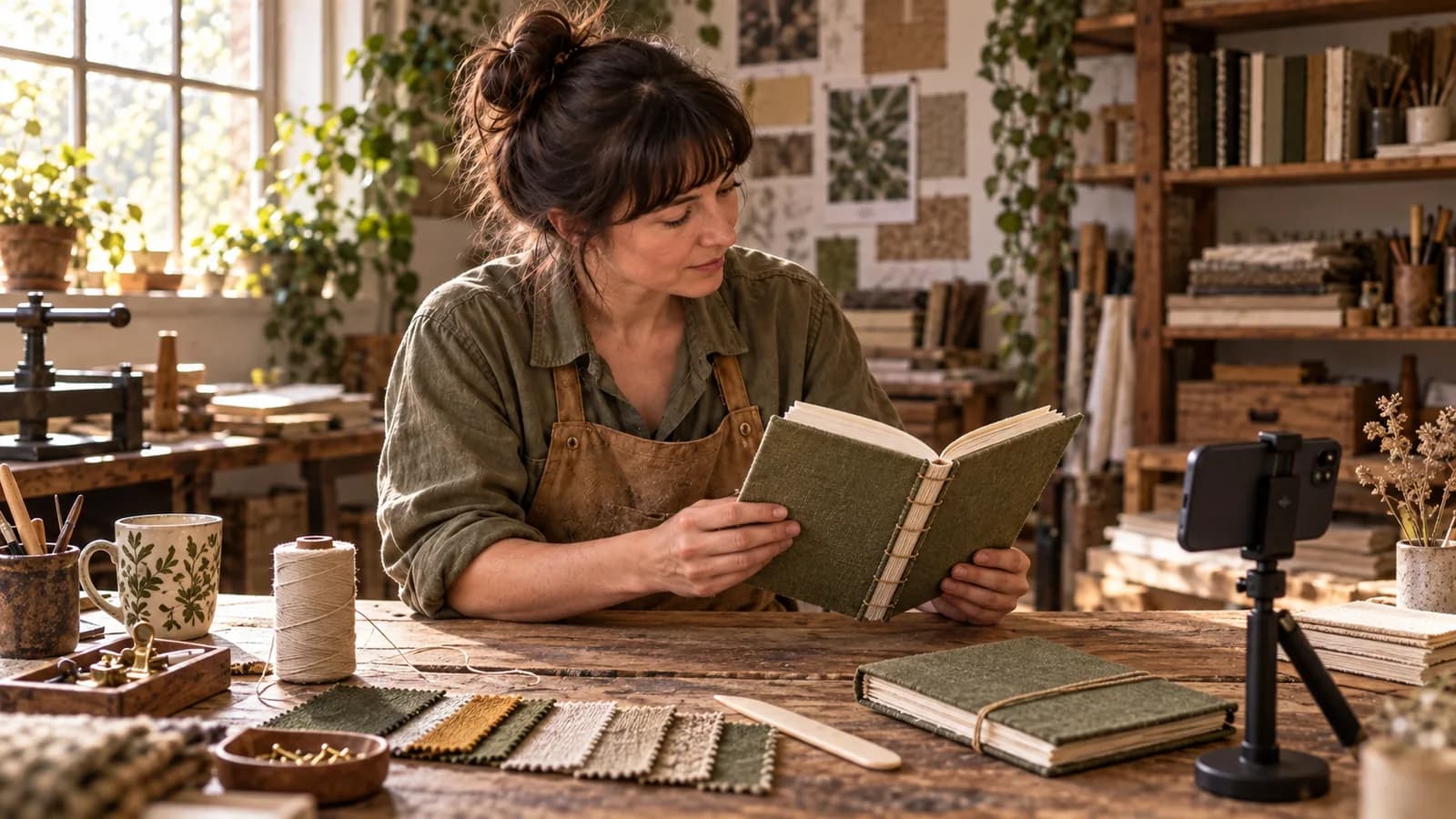
Keep the actual work as the source. The generated cover illustrates the idea; footage presented as evidence of your own making process should show that process.
A usable answer first
Use four questions: What is the customer wondering? What choice do we make? What can we show? What remains unproven?
For example, a buyer might ask how a handmade notebook opens. Show the binding construction and the finished notebook being opened. Explain the visible feature without turning a short clip into a promise about years of use.
Etsy's About-section guidance explicitly supports photos and video showing a workspace and creative process. That provides a place for the story. The editorial task is deciding which part of the process helps the customer understand the product.
Keep each story small enough to follow. Material selection, assembly and a final check can each be useful subjects, but placing all three in a rapid montage may leave none explained.
Worked brief
Imagine a small studio making cloth-covered notebooks with visible sewn bindings. The owner wants to explain how the notebook opens before a seasonal collection launch. The voice is calm and specific; the material is real footage of the current design.
The proposed sequence has three frames: a view of the binding, a short action showing the notebook opening, and a finished view showing the pages in use. The maker narrates what the viewer is seeing. If opening behaviour depends on the binding or paper, the explanation names that actual condition.
A possible caption is: “Here is how this notebook opens. The exposed stitching joins the sections; this clip shows the finished book on our workbench. See the product page for its size, paper and current cover choices.” Use that wording only if it describes the notebook being filmed.
The clip answers an observable question. It does not prove that the book can withstand every kind of handling, that all handmade bindings behave alike, or that a particular technique is superior in every situation.
A final inspection can become another story: what the maker looks at and what happens when an item needs further work. Avoid presenting one attractive inspection scene as evidence that every item has passed an independent certification.
Steps and checkpoints
- Start with the buyer's uncertainty. Write a question that could change how someone understands the product. “What happens in the studio?” is broad; “How does this notebook open?” gives the footage a job.
- Ask the maker to name the decision. Record the actual choice and its reason before writing a caption. If the explanation relies on a performance claim, obtain suitable evidence or narrow the statement to what can be shown.
- Choose a visible action. Keep enough context to identify the item and step. Do not assemble unrelated shots in a way that suggests a sequence you did not record.
- Capture the result of that action. Pair the process with the relevant finished detail. A close view of stitching needs an opening view if opening is the question.
- Add plain-language context. Explain unfamiliar terms and distinguish the current design from samples or experiments. Shopify's guide to instructional posts recommends breaking a process into understandable steps without assuming prior knowledge.
- Check the complete piece. Review the crop, caption, spoken explanation and destination together. Ask someone unfamiliar with the product what they now understand and what they still need to know.
Store the original footage with its context and permitted uses. Our workshop-photo library guide covers that separate preparation task, so the explanation does not disappear when the next person reuses the file.
Reusable worksheet
Copy these fields into a blank record and fill them using your actual product. The example is a proposed editorial plan, not evidence of a campaign result.
| Field | Notebook example |
|---|---|
| Customer question | How does this notebook open? |
| Decision to explain | The binding used for this design |
| Detail shot | The sewn spine, with the book identifiable |
| Action shot | The finished notebook being opened |
| Result shot | Pages in use on the workbench |
| Supported statement | What the recorded construction and action show |
| Limit | No lifetime or universal durability claim |
| Next step | Current size, paper and cover information |
Add the source files, permission record, factual reviewer and review date to your own working copy. Do not fill an unknown field with a more polished adjective.
The same material can support distinct pieces: a short opening demonstration, an image explaining the binding, and a post answering a follow-up question. Each should preserve the same product facts while doing a different job.
Failure modes
The story shows effort but explains nothing. A long time-lapse may be visually interesting without answering the buyer's question. Add the decision and finished detail, or choose a narrower scene.
A staged demonstration looks like ordinary production. If a process is slowed down or repeated for clarity, describe it as a demonstration where that distinction matters. Do not imply a clip is an unedited record of every order.
The camera creates a stronger claim than the caption. Dramatic bending or pulling may look like a durability test. Use an appropriate demonstration and avoid implying a standard you have not evaluated.
Natural variation becomes the wrong story. Showing production explains how an item is made. Explaining what can differ between pieces requires a separate comparison of actual stock. Our handmade-variation guide helps keep those two questions separate.
Everything becomes public. Leave customer details, private orders and work you lack permission to show outside the frame. A useful process story does not require unrestricted access to the business.
From one-off to recurring
The repeatable asset is the explanation: the customer question, the real decision, the source footage and the claim boundary. Keep these together when preparing the next collection or a different format.
Try MultiCast when turning that source material into regular branded content becomes the time-consuming part. Its public product page describes campaign planning, brand-guided voice, use of your own photos and per-piece approval. Those are relevant capabilities to evaluate with one process story and the images you have already checked.
Bring the real material and approved explanation into the campaign brief, then review how the demonstration, detail post and follow-up fit together. The advantage to look for is a consistent brand direction without starting each piece from a blank brief. Keep factual approval with the person who knows the work.
For an occasional story, a document and a few organised files may be enough. A recurring series is a good reason to explore a more connected preparation workflow. Find more practical routines in our organic marketing guides.
Evidence and updates
Sources checked October 13, 2026. Etsy and Shopify provide platform and instructional-content guidance; MultiCast describes its advertised product. The four-question method, notebook example and worksheet are our editorial proposals. No sales lift, time saving or account-level software test is claimed.
The cover is generated editorial artwork featuring our recurring fictional Clara character. Revisit the explanation when the product, process, source footage or permitted use changes.
 MultiCastMARKETING, TOGETHER.
Good ideas deserve a consistent campaign.
Bring your next marketing idea to MultiCast. Keep your brand at the center, from planning to publishing.